- This canvas is often favored by product managers, as the concepts of problem and solution are popular in product management circles.
- The addition of an unfair advantage lets the user specify what is unique about their proposed business model. It's something that would be difficult to copy tomorrow even with a lot of money (e.g., brand strength, a large community of users, a special algorithm).
Wednesday, March 20, 2019
Lean

Tuesday, March 19, 2019
The Unfair Advantage: Business
A large community of users
An instantly-recognized brand
Proprietary technology including algorithms
Strategic contracts or partnerships with major companies
An instantly-recognized brand
Proprietary technology including algorithms
Strategic contracts or partnerships with major companies
Wednesday, March 13, 2019
UX Design - Typography
Orphan - Last word in the paragraph
Underlying grid system; the number of grids is up to the designer.
http://thinkingwithtype.com/grid/
When you are mixing fonts, mix san serif and serif together
Imaginary grid lines - make sure elements line up or align properly
Margins - between the side of the page and where the content lies
Golden Section, surprising properties
Multicolumn Grid
While single-column grids work well for simple documents, multicolumn grids provide flexible formats for publications that have a complex hierarchy or that integrate text and illustrations. The more columns you create, the more flexible your grid becomes. You can use the grid to articulate the hierarchy of the publication by creating zones for different kinds of content. A text or image can occupy a single column or it can span several. Not all the space has to be filled.
Underlying grid system; the number of grids is up to the designer.
http://thinkingwithtype.com/grid/
When you are mixing fonts, mix san serif and serif together
Imaginary grid lines - make sure elements line up or align properly
Margins - between the side of the page and where the content lies
Golden Section, surprising properties
Multicolumn Grid
While single-column grids work well for simple documents, multicolumn grids provide flexible formats for publications that have a complex hierarchy or that integrate text and illustrations. The more columns you create, the more flexible your grid becomes. You can use the grid to articulate the hierarchy of the publication by creating zones for different kinds of content. A text or image can occupy a single column or it can span several. Not all the space has to be filled.
Wednesday, March 6, 2019


Steve Portigal - Discover and Act on Insights
Top-line Summary
Participatory Design
You're involving other people in the process who bring different perspectives.
You're communicating with other team members, such as a developer or product manager.
Doesn't mean we implement the requested solution literally. "I wish it had a handle." Designers work with this data to generate alternatives.
Engage people in the non-literal through games and role playing
Undercover underlying principles and explore areas that don't yet exist
Indirect: new information into our culture
Madness in Methods
to provide fragments to the questions with the people
The "Lunch Buffet" Terminology
Ethnography
Ethnographic Interviews
Video Ethnograpphy
Depth Interviews
Contextual Research
Design Research
Overarching Framework
We examine people; we're exploring context
Gathering stories
What does the thing they are doing mean?
finding connections
Crowdsourcing: Reflecting on how their behaviors have changed with the product
Participatory Design: Discovering one's needs as it pertains to the product
Topline Summary - A preliminary outline of key themes and emerging ideas
Examine Using a range of methods:
Interview
Tasks
Participation
Demonstration
Role-playing
To start a culture change we need to do two simple things
1. do dramatic story-worthy things
that represent the culture we want to create
2. find other people who do story-worthy things. then, tell stories about them.
Cultural Insights drive culture change and innovation
re-creating an ordinary task
latent behavior that participant wasn't aware of
Coffee Control (Persona Comic)
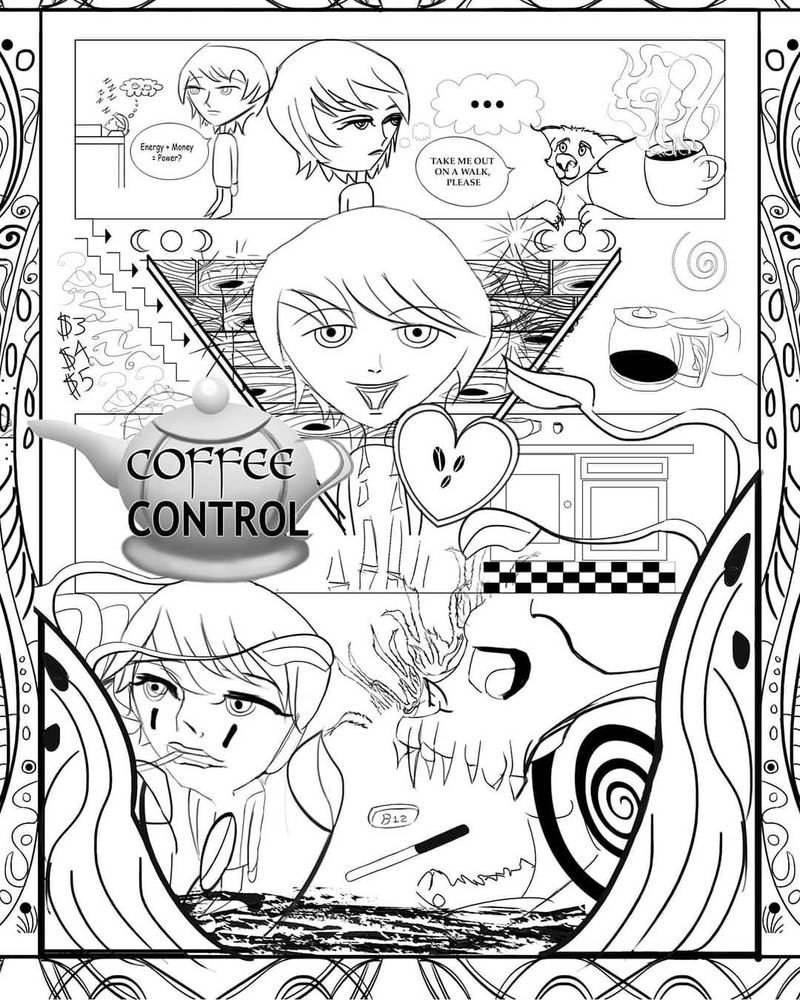
Persona 1 is addicted to both coffee and cigarettes.... He enjoys drinking his coffee black with 2 sugars and while smoking a cigarette each morning. He does not like coffee shops because it is too expensive despite each product costing around the same as his pack of cigarettes. When he explains what he loves about drinking coffee and smoking cigarettes so much, he says "everything about it" and each time he is asked how often he drinks coffee, he says, "every single day." Persona 1 drinks his coffee hot "always". When Persona 1 does not get enough energy after the morning, he often drinks coffee in the afternoon or at night to stay awake.
Persona - Jack

Tuesday, March 5, 2019
Coffee Research Project
Research:
Specialty coffee sales are increasing by 20% per year and account for nearly 8% of the 18 billion dollar U.S. coffee market. Coffee statistics show that among coffee drinkers the average consumption in the United States is 3.1 cups of coffee per day.
http://www.e-importz.com/coffee-statistics.php

Journey Map: Between Waking Up and Drinking Coffee
Participant 1 wakes up and is desiring a food product that will provide them enough energy to accomplish their tasks in the day. Coffee is a beverage that contains caffeine and gives energy to consumers that are tired, especially after sleep or a long nap.
They need something to boost their energy levels for work and daily routines. They move to a kitchen or a nearby coffee shop; they either brew their own coffee or tell the barista at the front counter what kind of coffee they'd like to order. They inform the barista or mix for themselves the exact amount of sugar, milk, flavoring or cream they'd like to have in their coffee. They enjoy the smell of coffee beans that are either being grounded, or poured as grounds in a coffee brewer. They drink their coffee. typically out of a mug, styrofoam or paper cup. The coffee that is either iced or hot provides an enjoyable feeling of comfort, expecially depending on the day's temperature if it is either the winter when it is really cold outside and customers are desiring hot beverages or, if it is the summer when people are desiring cold beverages to keep them cool from the hot weather.
Participant 1
Participant 2
Participant 3
Participant 4
Participant 5


Portioning of Sweetener
Sugar
Splenda
Sweet N' Low
Blue Equal
Black (No Sweeteners)
Dairy
Whole Milk
Cream
Skim Milk
Black (No Dairy)
Flavoring
Sweetened
Flavoring
Unsweetened
Flavoring
Iced or Hot
Iced
Hot
Stirred or Not Stirred
Stirred
Not Stirred
Mug, Paper or Thermos
Mug
Paper
Thermos
Enjoyment of Taste
Versus
Enjoyment of Energy
Sources:
http://www.e-importz.com/coffee-statistics.php
https://www.statisticbrain.com/coffee-drinking-statistics/
https://www.hamiltonbeach.com/facts-about-coffee-consumption-infographic
Specialty coffee sales are increasing by 20% per year and account for nearly 8% of the 18 billion dollar U.S. coffee market. Coffee statistics show that among coffee drinkers the average consumption in the United States is 3.1 cups of coffee per day.
http://www.e-importz.com/coffee-statistics.php
Journey Map: Between Waking Up and Drinking Coffee
Participant 1 wakes up and is desiring a food product that will provide them enough energy to accomplish their tasks in the day. Coffee is a beverage that contains caffeine and gives energy to consumers that are tired, especially after sleep or a long nap.
They need something to boost their energy levels for work and daily routines. They move to a kitchen or a nearby coffee shop; they either brew their own coffee or tell the barista at the front counter what kind of coffee they'd like to order. They inform the barista or mix for themselves the exact amount of sugar, milk, flavoring or cream they'd like to have in their coffee. They enjoy the smell of coffee beans that are either being grounded, or poured as grounds in a coffee brewer. They drink their coffee. typically out of a mug, styrofoam or paper cup. The coffee that is either iced or hot provides an enjoyable feeling of comfort, expecially depending on the day's temperature if it is either the winter when it is really cold outside and customers are desiring hot beverages or, if it is the summer when people are desiring cold beverages to keep them cool from the hot weather.
Participant 1
Participant 2
Participant 3
Participant 4
Participant 5
Interview with Participant 1 (home)
12/15/2018
How do you like your own coffee?
Caffeinated
steam milk
full bodied
strong coffee
lattes - 1 percent milk
Taste, smell and thought of being woken up?
Everything. The taste, smell, and the caffeine to get out of bed.
Would you say that environment is important for having coffee?
No, it doesn’t matter
What about the Coffee shop versus home experience?
Getting a coffee at home -
First thing at home; I don’t really want it at a coffee shop
When I do go to a coffee shop, it’s in the afternoon or when I’m in a rush
I would want the coffee fast; instantaneous
Someone else making the coffee is usually not strong enough
In the process, I choose several rounded scoops of coffee grounds
Sweetener or without?
Without sweetener
Hot or Iced?
Hot
Mug, thermos, plastic, cup?
Mug
How does it affect your daily routine?
It feels sluggish without coffee, like I’ll be missing something for most of the day.
Espresso versus regular coffee?
Espresso drinks
Interview with Participant 2 (café)
12/15/2018
How do you like your own coffee?
Keurig; but at a coffee shop, iced
I’m not a huge fan of Dunkin’ coffee though
Why specifically a Keurig?
It’s quicker than the traditional way and I found a bunch of K-Cup flavors I love.
Is there anything about the process of making the coffee with the Keurig that makes it better than, say, a regular coffee maker?
I can make it one cup at a time versus a whole pot, it’s also less messy cause it’s ready to go in the k-cup
Coffee shop versus home experience?
Home
Getting a coffee at home or café?
At coffee shops they can make more complex drinks of better quality with a wider variety in flavor, take lattes or macchiatos for example. It costs more to go to a coffee shop but it can be fun to go out with friends and catch up while drinking coffee. Staying at home is good too though because you can just relax in your pjs and watch Netflix. Also it’s cheaper! For me it depends on my mood, but I tend to like just staying at home better given that I’m an introvert at heart
Hot or Iced?
Hot
What about the experience of someone else making your coffee for you? what about it is different than you making it by yourself?
I hardly have anyone make me coffee. They’d usually make it wrong
Caffeine or Taste?
The addiction to the caffeine is more that I’ll get migraines and even throw up sometimes from them if I go too long without coffee. The taste of coffee is less of an addiction, but more that I just really love it
Mug, thermos, plastic, cup?
Mug
How many cups of coffee a day?
I used to drink around 5 or 6 until a couple months ago I started to cut down. Now I drink one or two a day
Espresso versus regular coffee?
Regular coffee
Paragraph Summary
Participant 1 (home) was interested in the portioning of her coffee whereas Participant 2 (cafe) was less worried about portioning and more interested in the caffeine. Participant 2(cafe) had her coffee iced whereas Participant 1 (home) had her coffee served hot. Participant 1 (home) enjoyed the comfort of the room's space and lighting. Participant 2 was less interested in the room and more interested about the social situation. Participant 1 (home) had the coffee with steamed milk and Participant 2(cafe) just had regular iced coffee. Participant (2) (cafe) seemed less interested in the amount of portioning then Participant 1 (home) who had her coffee with rounded scoop of coffee grounds.
It would be interesting to think of how to improve a few subtle steps in the coffee making process since a lot of people I interviewed had a specific way of making it. For instance, in drive-thru, where there are lines of cars, cafés might need to consider having more than one window to deliver the beverage. Or, in cafes where baristas need to meet the specific needs of flavoring and portioning in each customer’s drink, cafes may want to expand on the customizations of each drink. Customers that don’t get the right order may blame the barista for the mistake of not hearing him or her correctly. This however isn’t always correct and coffee making machines for the future may be necessary. Cumberland farm offer these machines to customers and surprisingly have placed them past Dunkin’ in New England as more and more consumers care more about the accuracy of the product versus the actual restaurant experience
Portioning of Sweetener
Sugar
Splenda
Sweet N' Low
Blue Equal
Black (No Sweeteners)
Dairy
Whole Milk
Cream
Skim Milk
Black (No Dairy)
Flavoring
Sweetened
Flavoring
Unsweetened
Flavoring
Iced or Hot
Iced
Hot
Stirred or Not Stirred
Stirred
Not Stirred
Mug, Paper or Thermos
Mug
Paper
Thermos
Enjoyment of Taste
Versus
Enjoyment of Energy
Sources:
http://www.e-importz.com/coffee-statistics.php
https://www.statisticbrain.com/coffee-drinking-statistics/
https://www.hamiltonbeach.com/facts-about-coffee-consumption-infographic
User Research: Analyzing Data
It's not enough just to conduct research.
You need to do something with it in order to uncover insights.
Analyzing data for research is important because:
-It forces you to consider different aspects of the user experience you may not otherwise have considered.
-Is a way to pull together all of your various research in order to think about it critically.
-It will help teams make more informed design decisions moving forward.
-It can prove your assumptions or hypothesis, or provide an alternative reality (that you may have never expected).
Personas are controversial because they highlight on ideal participants rather than real ones.
Personas usually have a summary or key quote and highlight on the frustrations, needs and goals.
Working team members is important because:
-When you don't actually do something with your research, it's wasted energy and effort.
-Sharing your findings and insights helps keep everyone on the team on the same page and working towards the same goal(s).
-Thinking critically about the data you have collected will give you a competitive advantage as you discover and uncover aspects of behaviors that other companies may not have considered.
-To ensure everyone has a clear definition of what you're talking about.
Large scale affinity diagrams are useful because:
-They examine the relationship of ideas.
-When teams work together it fosters collaboration and the exchange of ideas.
-It's easy to move ideas around .
-Without pre-defined ideas, you're able to work as a team to uncover different themes, patterns and insights.
Spreadsheets are useful because
-it keeps all the info in one place
-it is stored on the computer
Journey Maps are a useful way to:
-Examine each step of a user experience or journey in more detail, highlighting key moments.
-In addition to examining the start and end point of an experience, they also encourage examining what happens before and after those moments.
-They can be created collaboratively and foster discussion.
-They mark the emotional journey as well as the behaviors of the user.
You need to do something with it in order to uncover insights.
Analyzing data for research is important because:
-It forces you to consider different aspects of the user experience you may not otherwise have considered.
-Is a way to pull together all of your various research in order to think about it critically.
-It will help teams make more informed design decisions moving forward.
-It can prove your assumptions or hypothesis, or provide an alternative reality (that you may have never expected).
Personas are controversial because they highlight on ideal participants rather than real ones.
Personas usually have a summary or key quote and highlight on the frustrations, needs and goals.
Working team members is important because:
-When you don't actually do something with your research, it's wasted energy and effort.
-Sharing your findings and insights helps keep everyone on the team on the same page and working towards the same goal(s).
-Thinking critically about the data you have collected will give you a competitive advantage as you discover and uncover aspects of behaviors that other companies may not have considered.
-To ensure everyone has a clear definition of what you're talking about.
Large scale affinity diagrams are useful because:
-They examine the relationship of ideas.
-When teams work together it fosters collaboration and the exchange of ideas.
-It's easy to move ideas around .
-Without pre-defined ideas, you're able to work as a team to uncover different themes, patterns and insights.
Spreadsheets are useful because
-it keeps all the info in one place
-it is stored on the computer
Journey Maps are a useful way to:
-Examine each step of a user experience or journey in more detail, highlighting key moments.
-In addition to examining the start and end point of an experience, they also encourage examining what happens before and after those moments.
-They can be created collaboratively and foster discussion.
-They mark the emotional journey as well as the behaviors of the user.
Subscribe to:
Comments (Atom)

-
Top-line Summary Participatory Design You're involving other people in the process who bring different perspectives. You'r...
-
Research: Specialty coffee sales are increasing by 20% per year and account for nearly 8% of the 18 billion dollar U.S. coffee market. Cof...


